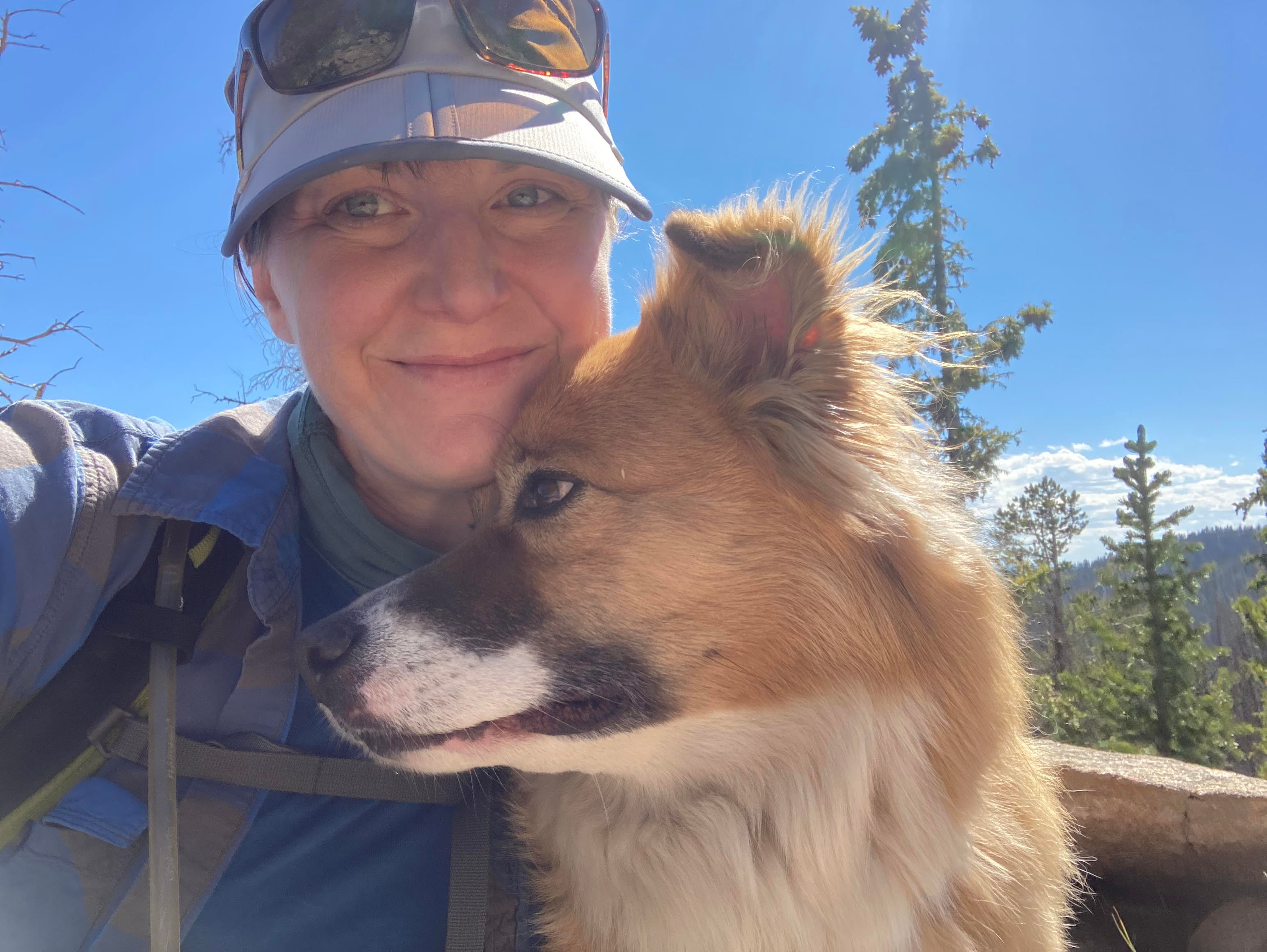
Ricki Garden is the stewardship coordinator at Central Colorado Conservancy and the Environmental At-Large representative on the Arkansas Basin Roundtable. With a background in civil engineering and years of seasonal river and wetland restoration work across the West, she eventually found her home in the Arkansas River Valley. In addition to her role with the Conservancy, she serves on the board of Trout Unlimited and has been an active volunteer in Salida’s conservation community.
In this conversation, Ricki sat down with Cecilia Timberg, ARWC’s Communications Coordinator, to share the path that brought her to the Basin, her vision for representing the environment at the Roundtable, and how community, balance, and passion for the river guide her work.
Cecilia: Let’s start with introductions. Who are you and what’s your current role?
Ricki: My name is Ricki Garden. I work for Central Colorado Conservancy as a stewardship coordinator. My work is stewarding land as well as wetlands and stream restoration projects. Getting here was a circuitous path. I’ve been volunteering in Salida for about two years on various boards, working with Trout Unlimited, and was recently appointed the Arkansas Basin Roundtable’s Environmental At-Large representative.
Cecilia: What is your role with the Arkansas Basin Roundtable? What does it mean to be the at-large environmental representative?
Ricki: The roundtable is made up of representatives from different backgrounds—counties, municipal, industrial, agricultural, recreational, and environmental. My role is to represent the environment. Not a specific place or organization, but the environment itself.
The environmental and recreation committee is one of the oldest subcommittees, and one of the most active. We focus on non-consumptive needs in the basin—improving habitat, restoring wetlands, enhancing recreational experiences, protecting watershed health. Environmental and recreation often go hand in hand—if you improve habitat, boaters and anglers usually benefit too.
Cecilia: For those who may not know, what does it mean that the Arkansas Basin is “overappropriated”?
Ricki: It means there are more requests for water than the rivers can supply. In drought years, junior water rights holders may have to turn off their ditches so senior rights holders can take their legal share. Simply put, it means that there just isn’t enough water to go around.
Cecilia: How did you end up joining the roundtable as the environmental representative?
Ricki: Someone stepped down and the position opened. Environmental representation is often underfilled, so they like to keep it active. At the time, I had just joined the Trout Unlimited board, and our president suggested me for the role.
I had already been sitting in on roundtable meetings virtually for years just to stay in the loop, so when the chance came to participate directly, I jumped on it. I went in, said I wanted to represent the environment, and they said yes.
Cecilia: What has that role looked like so far?
Ricki: A big part is reviewing project proposals and providing letters of support. That is cool because I have gotten to be involved with supported projects way before they come to fruition. We also help spread the word about funding opportunities from the Colorado Water Conservation Board and make sure strong environmental and recreational projects are in the mix.
Cecilia: You mentioned balance earlier—between agricultural, environmental, municipal, and recreational needs. Is there an ideal balance?
Ricki: I don’t think there’s ever a scenario where everybody’s completely happy. An old supervisor once told me, “If everybody’s happy, I’m not doing my job right.” There are always groups that will be dissatisfied. The goal is to make sure the most important needs across all sectors are met. Agriculture is critical, but so are recreation and environmental health, not to mention municipal drinking water. It’s always a balancing act.
Cecilia: How did you first become connected with the Arkansas River, and what path led you to becoming involved with water issues and ultimately joining the Roundtable?
Ricki: I came to the Arkansas River Valley in 2015 while working seasonal Forest Service jobs and pursuing river and wetland restoration. My background is in civil engineering—I worked at Boeing in Washington. While I was there, I witnessed the Elwha Dam removal and had a “eureka” moment. I remember seeing a woman who worked for the Forest Service standing there in muck boots just watching the river run free and thought, “That’s a job? I want to do that!”.
After that moment, I started volunteering with Trout Unlimited, took river restoration courses, and did seasonal hydrology jobs. Eventually the Forest Service work led me here. I moved around the West—Idaho, Montana, New Mexico, West Virginia—but nowhere passed what I call the “Salida test.” This valley felt like home. I just kept coming back.
Cecilia: What keeps you here?
Ricki: The community. People here are deeply invested in their land and waters, and the volunteerism is unlike anywhere else I’ve lived. You sometimes have to race for a volunteer slot because they fill so quickly. That kind of community energy is rare.
Cecilia: You’ve also just started your role as stewardship coordinator at Central Colorado Conservancy. How does that fit into your other work?
Ricki: It’s my dream job. I monitor conservation easements and look for stewardship opportunities—forestry help, wetland restoration, invasive species management. We visit each of our easements annually, often with the landowners, and I get to hear incredible stories of land and wildlife.
It intersects naturally with my other roles—I wear many hats, but they all come back to the same thing: My hope in every pursuit is to play a role in guiding a story of our waters enjoying a richness in both quality and quantity. In this story, the environment has no dialogue unless we give it a voice. In all my efforts, I try to be that voice.
Cecilia: Are there projects you’re especially excited about?
Ricki: The South Arkansas River Restoration Project in Salida is close to my heart. It covers 1.2 miles of private and city land where erosion has been a big issue. The project will stabilize the riverbank, protect infrastructure, and create interpretive signs to educate people about beavers and riparian health. I walk my dog along that stretch and remember thinking years ago, “This river needs fixing.” Now, we’re close to making it happen.
Cecilia: In your view, what’s the most significant water-related challenge in the basin?
Ricki: Balancing competing needs with a limited water supply. Agriculture, recreation, municipalities, and the environment all have valid claims. The basin is overappropriated, so compromises are necessary.
Cecilia: Finally, what do you think people outside the basin should understand about the Arkansas River?
Ricki: That there’s a deep-rooted passion for it. This river is known far beyond Colorado—for fishing, boating, its beauty. People come from all over the world to experience it. And locally, the river really does shape our community—it’s at the heart of why many of us live here.
Want to read more about Ricki’s work with Central Colorado Conservancy? Check out this article: Reflection on My First Summer of Monitoring